
After a busy summer of conferences in Europe and further afield, I have been thinking about the work that continues between meetings. Presenting research is one part of belonging to a scientific community. Helping people discover that research, find opportunities and feel able to take part is another.
My involvement with ESB-ITA continues, I have recently joined Y-GIMC, and I have been announced as a member of the next VPH Young Scientists Committee. These are different commitments, with different rhythms and communities, but they share an opportunity to contribute beyond my own research.
ESB-ITA: continuing the conversation
My adventure with ESB-ITA, the Italian Chapter of the European Society of Biomechanics, continues. After an intense summer attending conferences and representing the Italian chapter in and outside Europe, we met again at the ESB-ITA meeting in Milan. It was a chance to reconnect in person and carry those conversations forward.
I remain part of the Communication Working Group. Social networks are a visible part of that work, but communication also means making activities and opportunities easier to find, giving the chapter’s initiatives a coherent presence, and helping information reach the people it is intended for.
The group’s remit includes communication through the website, LinkedIn, YouTube and the newsletter, alongside the promotion of membership and activities across the chapter. For me, the interesting challenge is turning a varied stream of research, events and opportunities into something clear, recognisable and useful to follow.
Y-GIMC: helping a new committee find its voice
I have also recently joined Y-GIMC, the Young Committee of the Italian Group of Computational Mechanics. It is a recently formed committee, and we are beginning to work on how the group communicates online and connects with younger researchers.
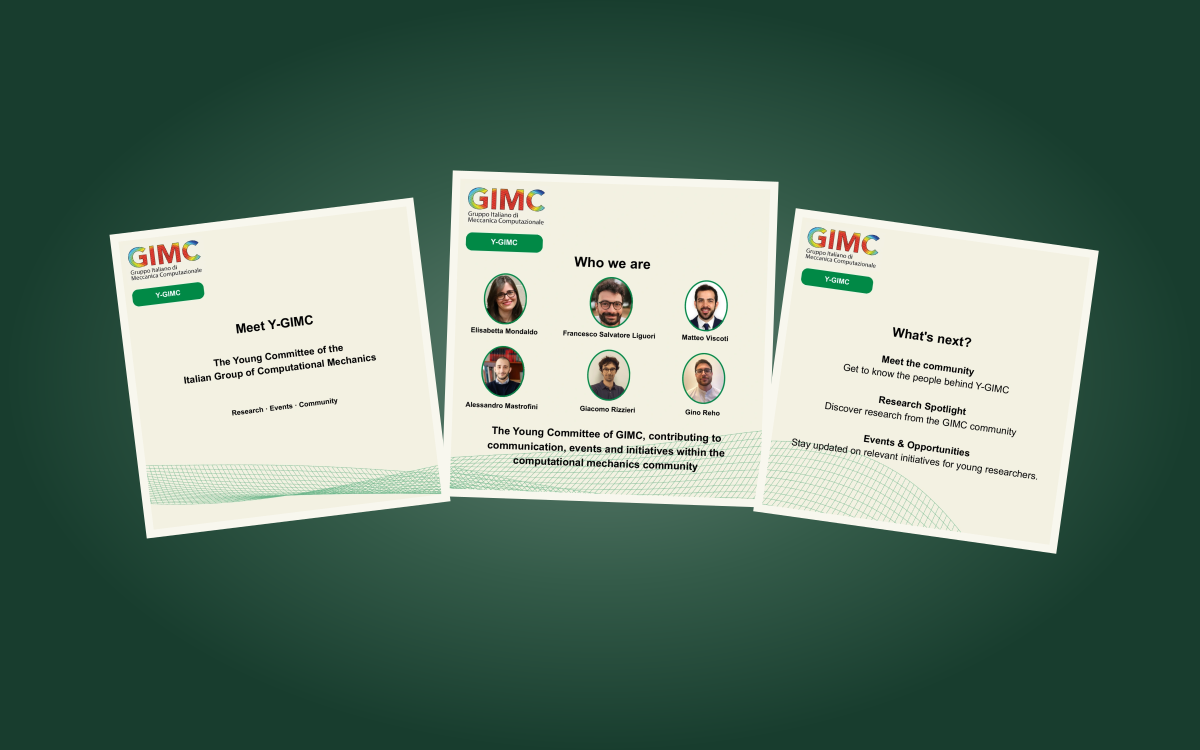
We are starting with a coordinated series of posts, a shared graphic language and an editorial plan. The three slides below belong to one introductory social-media carousel, shown side by side here so the sequence can be read together. The aim is to give the content continuity: introduce the people in the community, make research more visible, and share relevant events and opportunities in a form that is easy to recognise.
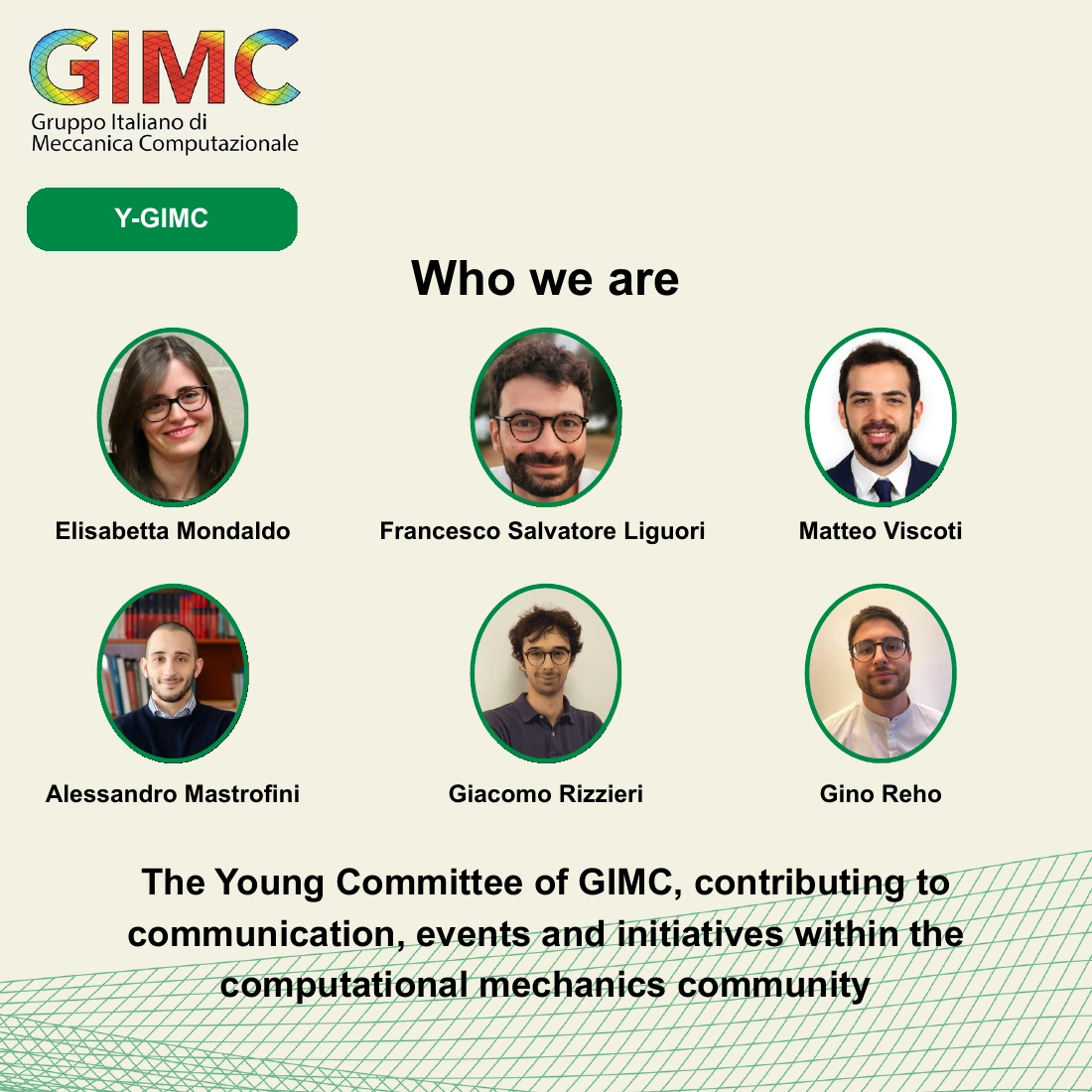
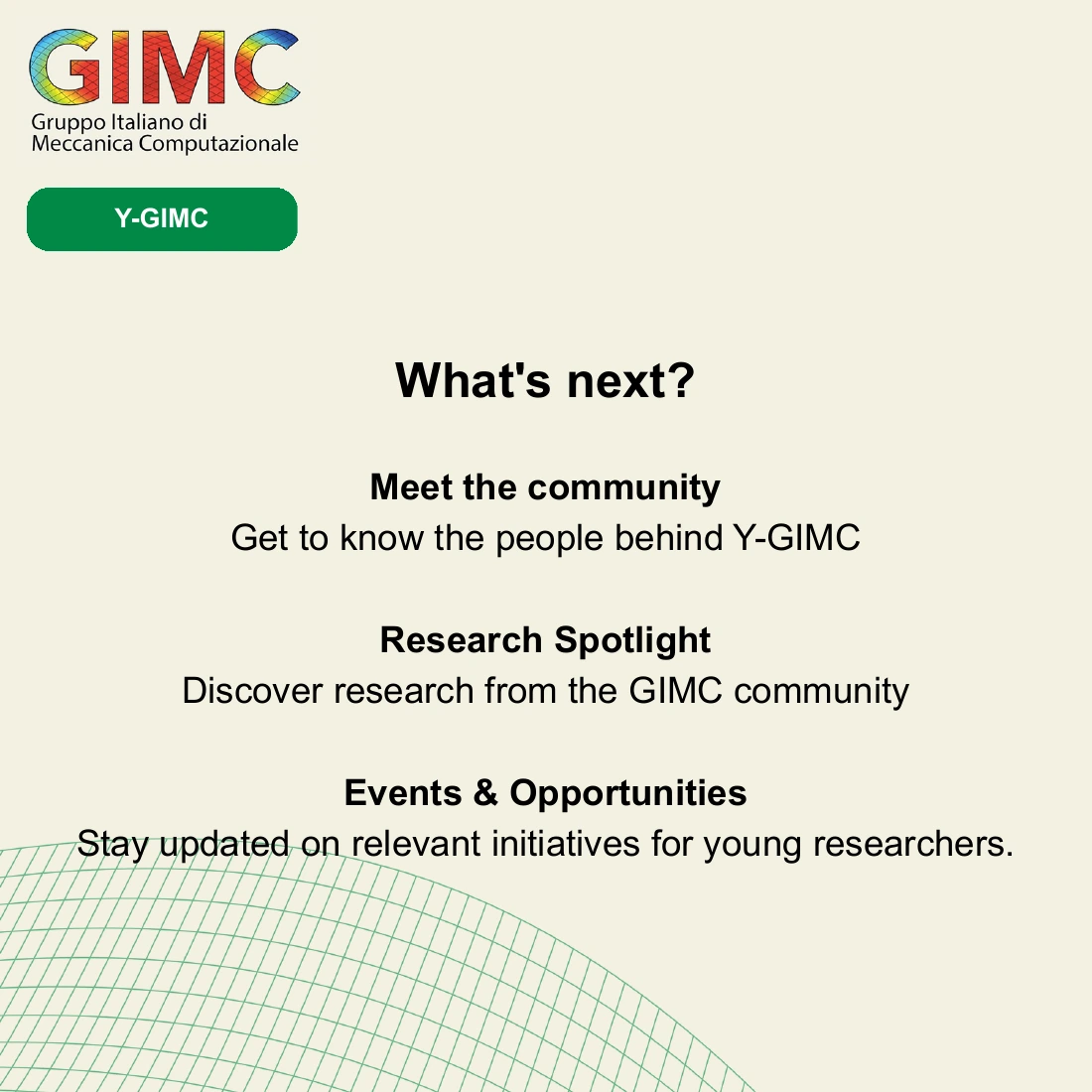
This first carousel sets out that direction. The repeated colours, typography and mesh motif make them feel like parts of the same conversation, while each slide has a distinct task: explain the committee, introduce its members or show what is coming next. Open an image to see the full design.
There is more to discover over the coming months. We are at the beginning of the work, and I am looking forward to seeing the visual identity develop through the actual stories and people it will help present.
VPH: a new role ahead
The next step is with VPH, the Virtual Physiological Human community and Society for In Silico Medicine. My appointment to the Young Scientists Committee for 2027–2028 has recently been announced, with the mandate beginning in January 2027 and continuing through December 2028. The society has also shared the official announcement on LinkedIn.
The Young Scientists Committee supports students and early-career researchers across in silico medicine through opportunities for exchange, professional development and participation. Its activities include webinars, workshops, mentoring and contributions to the VPH Summer School.
I am looking forward to bringing my perspective from computational biomechanics and scientific communication into that setting, while learning from researchers working on other parts of in silico medicine. The appointment is the start of that involvement; the specific work we will develop belongs to the coming mandate.
Different commitments, a shared reason to take part
These roles are related without being interchangeable. ESB-ITA connects me to the Italian biomechanics community. Y-GIMC offers a new setting in computational mechanics, with a communication project taking shape. VPH brings a broader in silico medicine perspective and a new international committee to work with.
The commitments are different, but manageable when the work is shared and the scope is clear. Each group brings different ideas, people and ways of approaching a problem. What I enjoy is the possibility of contributing something useful in each setting, then bringing those experiences back into the way I work with the others.
For now, there is continuity with one community, a new beginning with another, and a new mandate ahead. I am glad to be part of the work that keeps those connections active between conferences.
I believe that communicating science is at least as important as doing the research itself. An important first step is keeping our scientific communities and societies active: creating spaces where people can meet, exchange ideas and recognise the work happening around them. A clearer view of the community helps us share its research more widely and bring the contributions of individual scientists into focus.